
Professional Guide to Boron Supplementation in Reef Aquariums
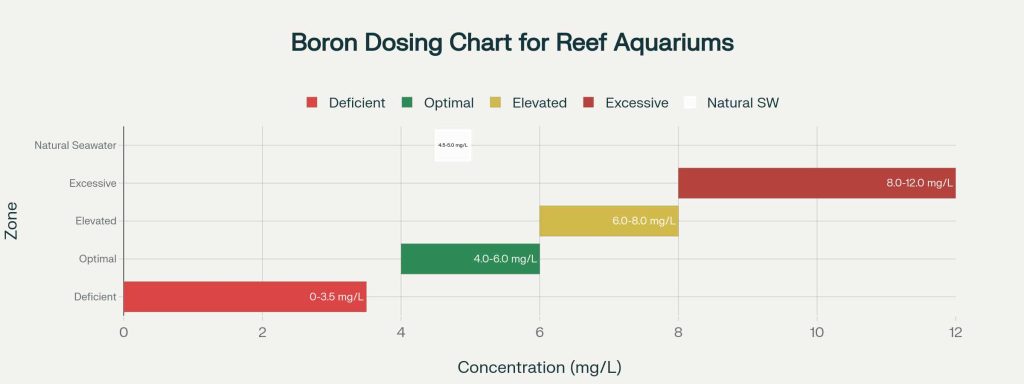
Boron represents a crucial macro-trace element in marine aquarium chemistry, functioning as both a buffering agent and essential component for coral physiology. While naturally occurring at concentrations of 4.5-5.0 mg/L in seawater, boron requires careful management in closed reef systems due to its dual role in pH stabilization and biological processes.
Understanding Boron’s Role in Marine Chemistry
Natural Seawater Concentrations and Chemical Forms
Boron occurs naturally in seawater at concentrations ranging from 4.5-5.0 mg/L, making it one of the more abundant trace elements despite its classification as a micronutrient. This element exists primarily as boric acid (H₃BO₃) at normal seawater pH levels, with a small fraction present as borate ions (B(OH)₄⁻). The distribution between these two species is pH-dependent, with the borate form becoming more prevalent at higher pH values above 8.5.
The stability of boron in seawater contributes to its importance as a geochemical tracer and its essential role in marine ecosystems. Unlike many trace elements that show significant spatial and temporal variation, boron maintains relatively consistent concentrations across ocean basins, making it a reliable reference point for aquarium supplementation programs.
pH Buffering and Carbonate System Interactions
Boron contributes to seawater’s buffering capacity through the boric acid/borate equilibrium system, although this contribution represents only a small fraction of total alkalinity. The borate system provides approximately 0.4 meq/L of buffering capacity in normal seawater, equivalent to roughly 10% of the total buffering provided by the carbonate system. While this may seem minimal, the loss of boron from reef aquarium systems can result in measurably increased pH swings, particularly in systems with lower overall alkalinity.
The interaction between boron and the carbonate system extends beyond simple buffering effects. Research indicates that borate ions can compete with carbonate ions for incorporation into calcium carbonate structures, influencing both the rate and quality of calcification processes. This competition becomes particularly significant during periods of rapid coral growth when calcification rates are elevated.
Biological Functions in Coral Physiology
Cellular and Metabolic Processes
Boron serves essential functions in coral cellular physiology, particularly in membrane stability and cell wall integrity. The element acts as a cofactor in various enzymatic processes, including those involved in carbohydrate metabolism and protein synthesis. Research demonstrates that boron deficiency can lead to compromised cell membrane function, resulting in tissue detachment and reduced growth rates in both hard and soft corals.
The element’s role extends to photosynthetic processes within zooxanthellae, where it contributes to chlorophyll stability and electron transport chain function. Adequate boron levels support optimal photosynthetic efficiency, which directly impacts the coral’s energy budget and calcification capacity. This relationship becomes particularly critical in high-light aquarium environments where photosynthetic stress can compromise coral health.
Calcification and Skeletal Development
Recent research using boron isotope analysis has revealed the element’s complex role in coral calcification processes. Corals actively regulate the pH of their calcifying fluid (ECF) to promote aragonite precipitation, and boron incorporation into the skeleton provides insights into these internal pH regulation mechanisms. Studies demonstrate that corals can maintain elevated ECF pH levels even under challenging environmental conditions, with boron serving as both a participant in and recorder of these processes.
The incorporation of boron into coral skeletons follows predictable patterns related to calcifying fluid chemistry, with borate ions substituting for carbonate ions in the aragonite crystal lattice. This substitution occurs at ratios that reflect both ambient seawater conditions and internal physiological regulation, making boron a valuable tool for understanding coral responses to environmental change.
Aquarium Applications and Management Protocols
Target Concentrations and Monitoring Strategies
Reef aquarium boron levels should be maintained within the 4.0-6.0 mg/L range to mirror natural seawater concentrations and support optimal coral physiology. Values consistently below 3.5 mg/L may indicate deficiency conditions that can impact coral growth and health, while concentrations exceeding 6.0 mg/L suggest the need for reduced supplementation or investigation of unintended boron sources.
Regular monitoring through ICP-OES analysis represents the most reliable method for tracking boron levels, as standard aquarium test kits lack the sensitivity required for accurate trace element measurement. Testing intervals should align with overall trace element monitoring programs, typically every 6-8 weeks for established systems or monthly during initial setup and dosing optimization periods.
Dosing Protocols and Administration
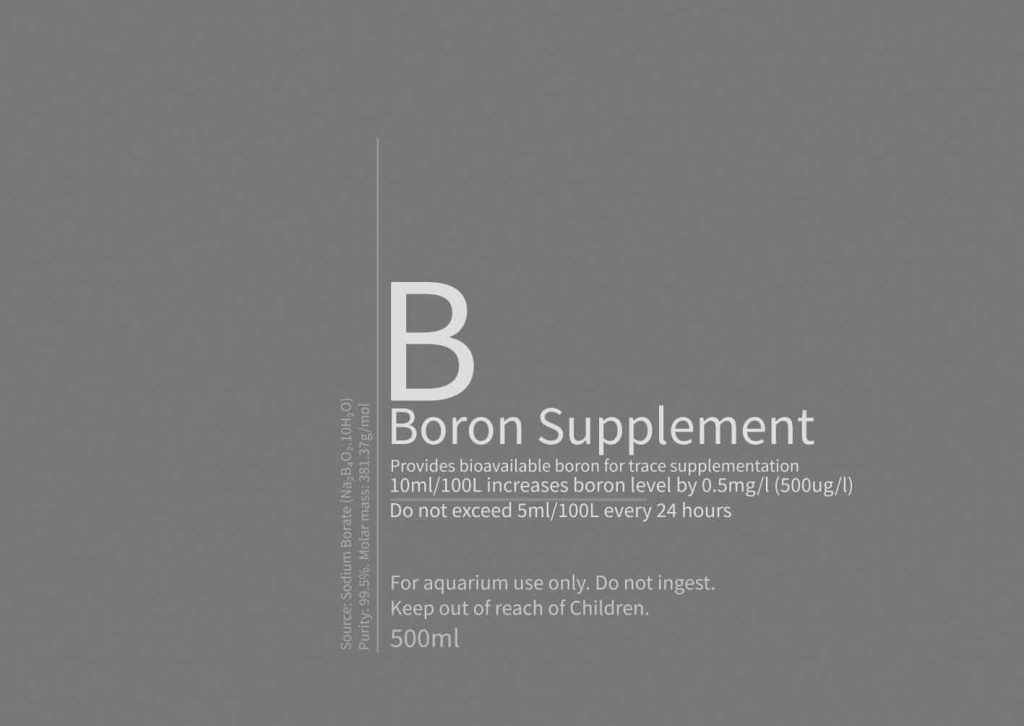
Based on the provided sodium borate decahydrate (Na₂B₄O₇·10H₂O) formulation with molecular weight 381.37 g/mol, the dosing protocol follows these parameters:
- Stock Solution: Sodium borate decahydrate (CAS 1303-96-4)
- Dosing Rate: 10 mL per 100L increases boron by 0.5 mg/L
- Maximum Safe Daily Dose: 5 mL per 100L (equivalent to 0.25 mg/L increase)
- Recommended Range: 4.0-6.0 mg/L
The conservative daily dosing limit reflects boron’s potential for bioaccumulation and the narrow margin between therapeutic and potentially harmful concentrations. For aquariums requiring significant boron correction, dosing should be distributed over multiple days to minimize stress on tank inhabitants and allow biological systems to adjust gradually.
Practical Dosing Calculations
For aquariums with deficient boron levels, the correction process requires careful calculation and gradual implementation. A 400L reef system with boron levels at 3.0 mg/L would require 120 mL of stock solution distributed over 6 days at 20 mL daily to reach optimal levels of 4.5 mg/L. This conservative approach prevents shock to coral and bacterial populations while ensuring steady progress toward target concentrations.
Safety Considerations and Toxicity Management
Toxicity Thresholds and Warning Signs
Boron toxicity in marine environments becomes a concern at concentrations significantly exceeding natural seawater levels. Research indicates that acute toxicity effects begin to manifest at concentrations above 8-10 mg/L in marine organisms, with chronic exposure to elevated levels potentially causing tissue damage and reproductive dysfunction.
In reef aquariums, boron toxicity may initially present as coral tissue recession, particularly in small polyp stony (SPS) corals, and reduced calcification rates across all calcifying organisms. Advanced toxicity can result in widespread coral mortality and disruption of beneficial bacterial populations essential for nitrogen cycling and system stability.
Chemical Stability and Interactions
Sodium borate decahydrate demonstrates excellent stability in marine aquarium conditions, with minimal degradation under normal storage and dosing protocols. The compound readily dissolves in seawater and distributes evenly throughout the system when added to areas of adequate water circulation.
The primary safety concern relates to the compound’s reproductive toxicity classification in concentrated forms, requiring careful handling and storage away from children and pets. While the diluted concentrations used in aquarium applications pose minimal risk, basic safety precautions including gloves and eye protection should be observed during stock solution preparation and handling.
Integration with Comprehensive Reef Chemistry
Relationship to Major and Minor Elements
Boron supplementation should be coordinated with broader trace element and major element dosing programs to maintain balanced seawater chemistry. The element’s interaction with the carbonate system means that changes in alkalinity, calcium, and pH can influence boron’s effectiveness and optimal dosing requirements.
Water changes using high-quality salt mixes typically provide adequate boron replenishment for many reef systems, particularly those with moderate bioloads and calcification demands. However, systems with intensive feeding regimens, high coral stocking densities, or extensive use of activated carbon may require supplemental boron dosing to maintain optimal levels.
Long-term Monitoring and System Optimization
Successful boron management requires integration with regular water quality assessment and systematic record-keeping. Trends in boron consumption can provide insights into system health, coral growth rates, and the effectiveness of other trace element supplementation programs.
The element’s stability in seawater makes it an excellent indicator of overall system balance, with sudden changes in boron levels often reflecting alterations in biological activity, filtration efficiency, or dosing protocols. Regular monitoring enables early detection of system imbalances and allows for proactive adjustments before coral health is compromised.
Advanced Applications and Research Insights
pH Regulation and Calcification Control
Recent research using boron isotope ratios in coral skeletons has revealed sophisticated pH regulation mechanisms that corals employ to maintain calcification under varying environmental conditions. These studies demonstrate that corals can elevate their internal pH by 0.5-1.0 units above ambient seawater, with boron serving as both a participant in and recorder of these processes.
Understanding these mechanisms provides insights into optimal aquarium conditions and the importance of maintaining adequate boron levels to support coral physiological functions. The research suggests that boron availability may influence coral capacity for pH regulation, potentially affecting their resilience to environmental stressors.
Trace Element Interactions and Synergies
Boron’s effectiveness in reef systems depends partly on the availability of other trace elements, particularly those involved in enzymatic processes and cellular metabolism. Deficiencies in complementary elements such as iron, zinc, or molybdenum can limit boron’s beneficial effects and may require coordinated supplementation approaches.
The element’s role in pH buffering also interacts with other buffering systems in seawater, including phosphate and silicate equilibria. While these interactions are generally minor in well-managed reef systems, they become more significant in systems with atypical water chemistry or specialized filtration protocols.
Troubleshooting and Problem Resolution
Deficiency Symptoms and Correction
Boron deficiency in reef aquariums typically manifests gradually, with initial symptoms including reduced coral growth rates and diminished coloration intensity. Advanced deficiency may result in tissue detachment, particularly in branching corals, and increased susceptibility to bacterial infections.
Correction of boron deficiency requires systematic approach combining immediate supplementation with identification and resolution of underlying causes. Common contributing factors include excessive use of phosphate removers that adsorb boron, inadequate water change frequency, or use of salt mixes with low boron content.
Excessive Levels and Remediation
Boron excess is typically easier to prevent than correct, making conservative dosing protocols essential for long-term success. When elevated levels are detected, immediate cessation of boron supplementation combined with increased water change frequency represents the most effective remediation approach.
Certain filtration media, particularly aluminum-based phosphate removers, may help reduce boron concentrations through adsorption mechanisms. However, such interventions should be monitored carefully to avoid disrupting other trace element balances or creating additional water quality issues.
Conclusion and Best Practices
Boron supplementation in reef aquariums requires a balanced approach that recognizes both the element’s essential role in coral physiology and its potential for causing harm when mismanaged. The narrow concentration range between beneficial and potentially toxic levels demands precision in both testing and dosing protocols.
Success with boron supplementation depends on understanding its multifaceted role in marine chemistry, from pH buffering to cellular metabolism. Regular ICP testing, conservative dosing approaches, and integration with comprehensive trace element management provide the foundation for safe and effective boron supplementation.
The growing body of research on boron’s role in coral calcification and pH regulation continues to refine our understanding of optimal aquarium management practices. As these insights develop, they emphasize the importance of maintaining natural seawater chemistry as closely as possible, with boron serving as both a critical nutrient and a valuable indicator of overall system health.