
Professional Guide to Bromine Supplementation in Reef Aquariums
Bromine represents one of the most abundant yet underappreciated trace elements in marine aquarium chemistry, ranking seventh in concentration among dissolved elements in seawater. At natural concentrations of 65-70 mg/L, bromine plays crucial roles in coral physiology, particularly in chromoprotein synthesis and fluorescent protein activation, making it essential for achieving optimal coral coloration and health.
Understanding Bromine’s Role in Marine Chemistry
Natural Seawater Concentrations and Chemical Forms
Bromine occurs naturally in seawater at concentrations ranging from 65-70 mg/L, making it significantly more abundant than many other trace elements commonly supplemented in reef aquariums. This element exists primarily as bromide ions (Br⁻) in seawater, with concentrations typically 300 times lower than chloride but substantially higher than elements like iodine or strontium. The stability of bromide in marine environments contributes to its consistent global distribution, making it a reliable reference point for aquarium supplementation programs.
Research indicates that bromide concentrations in natural reef environments typically range between 65-80 mg/L, with slight variations based on geographic location and local oceanographic conditions. This relatively high natural concentration suggests that bromine serves important biological functions that extend beyond simple trace element supplementation.
Chemical Stability and Environmental Interactions
Bromide demonstrates excellent chemical stability in seawater under normal aquarium conditions, with minimal degradation or precipitation under standard pH and temperature ranges. However, bromine chemistry becomes more complex in the presence of oxidizing agents, particularly ozone, where bromide can be converted to more reactive species including hypobromous acid (HOBr) and potentially toxic bromate ions (BrO₃⁻).
Studies on ozone treatment in marine systems reveal that bromide oxidation typically requires ozone doses exceeding 5 mg/L to produce detectable bromate levels, well above normal aquarium ozone applications. This finding suggests that standard ozone protocols pose minimal risk for bromate formation, though monitoring remains important in heavily ozonated systems.
Biological Functions in Coral Physiology
Chromoprotein Synthesis and Color Enhancement
Bromine serves essential functions in coral chromoprotein synthesis, particularly for the development of blue and purple pigments that contribute to coral coloration. Research demonstrates that corals utilize bromine as a reducing agent during chromoprotein synthesis, where it influences amino acid modifications that enable proper protein folding and chromophore formation. This process directly impacts the coral’s ability to produce the vibrant colors that make reef aquariums visually stunning.
The relationship between bromine and coral fluorescence extends beyond simple color enhancement. Studies indicate that bromine may play regulatory roles in DNA transcription processes within coral cells, potentially influencing the expression of fluorescent proteins and chromoproteins. This regulatory function explains why bromine supplementation often produces rapid improvements in coral coloration, with effects typically visible within days to weeks of initiation.
Calcification and Skeletal Development
Recent research using boron isotope analysis has revealed the element’s complex role in coral calcification processes. Corals actively regulate the pH of their calcifying fluid (ECF) to promote aragonite precipitation, and boron incorporation into the skeleton provides insights into these internal pH regulation mechanisms. Studies demonstrate that corals can maintain elevated ECF pH levels even under challenging environmental conditions, with boron serving as both a participant in and recorder of these processes.
The incorporation of boron into coral skeletons follows predictable patterns related to calcifying fluid chemistry, with borate ions substituting for carbonate ions in the aragonite crystal lattice. This substitution occurs at ratios that reflect both ambient seawater conditions and internal physiological regulation, making boron a valuable tool for understanding coral responses to environmental change.
Skeletal Development and Calcification Support
Beyond its role in pigmentation, bromine contributes to coral calcification processes through its incorporation into skeletal structures as sodium bromide. While not as critical as calcium or carbonate for skeleton formation, bromine appears to support the structural integrity of coral skeletons and may influence calcification rates under certain conditions.
Research on coral calcification indicates that bromine deficiency can result in reduced growth rates and increased skeletal fragility, particularly in rapidly growing species. However, the exact mechanisms by which bromine influences calcification remain an active area of research, with current evidence suggesting both direct incorporation into aragonite structures and indirect effects through metabolic processes.
Zooxanthellae Function and Photosynthetic Support
Zooxanthellae, the symbiotic algae essential for coral health, require small amounts of bromine for photosynthetic enzyme synthesis. This requirement links bromine availability to overall coral energy production and stress resistance, as healthy zooxanthellae populations enable corals to maintain calcification and growth under challenging conditions.
The interaction between bromine and photosynthetic processes becomes particularly important in high-light aquarium environments, where enhanced bromine availability may support increased photosynthetic efficiency and help corals manage light stress. Some research suggests that adequate bromine levels contribute to the coral’s ability to regulate zooxanthellae density, potentially preventing bleaching under moderate stress conditions.
Aquarium Applications and Management Protocols
Target Concentrations and Monitoring Strategies
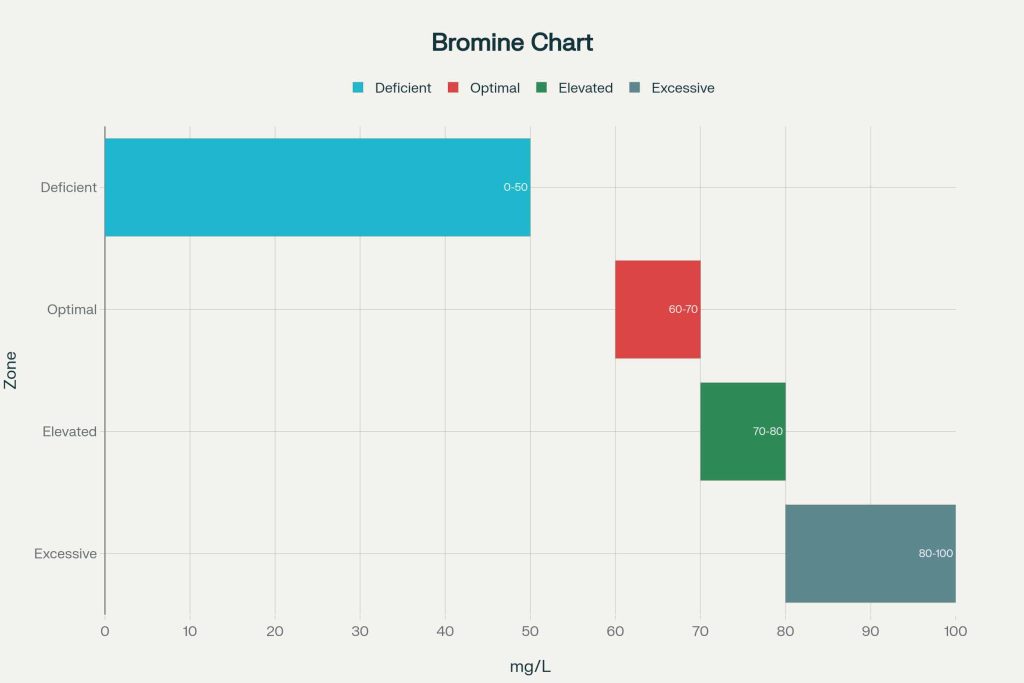
Reef aquarium bromine levels should be maintained within the 60-70 mg/L range to mirror natural seawater concentrations and support optimal coral physiology. Values consistently below 50 mg/L indicate deficiency conditions that can impact coral coloration and growth, while concentrations exceeding 80 mg/L suggest the need for reduced supplementation or investigation of unintended bromine sources.
Regular monitoring through ICP-OES analysis represents the most reliable method for tracking bromine levels, as standard aquarium test kits lack the sensitivity required for accurate measurement at these concentrations. Testing intervals should align with overall trace element monitoring programs, typically every 6-8 weeks for established systems or more frequently during initial supplementation periods.
Dosing Protocols and Administration

Based on the provided sodium bromide (NaBr) formulation with molecular weight 102.894 g/mol, the dosing protocol follows these parameters:
- Stock Solution: Sodium bromide (CAS 7647-15-6)
- Dosing Rate: 10 mL per 100L increases bromine by 5.0 mg/L
- Maximum Safe Daily Dose: 10 mL per 100L
- Recommended Range: 60-70 mg/L
- Daily Consumption: 0.7-1.2 mg per 100L in heavily stocked systems
The dosing protocol allows for efficient correction of bromine deficiencies while maintaining safety margins. A typical 400L reef system with bromine levels at 50 mg/L would require 120 mL of stock solution distributed over 3 days at 40 mL daily to reach optimal levels of 65 mg/L.
Practical Implementation and Timing
Bromine supplementation should be administered during periods of peak coral activity, typically during daytime hours when photosynthetic processes are most active. The supplement can be dosed directly into high-flow areas of the aquarium to ensure rapid distribution and prevent localized concentration spikes.
For systems requiring significant bromine correction, doses should be distributed over multiple days to allow coral populations to gradually adapt to changing trace element profiles. This approach minimizes stress on tank inhabitants and reduces the risk of adverse reactions in sensitive species.
Fluorescence Enhancement and Visual Effects
Mechanism of Color Enhancement
Bromine’s impact on coral coloration operates through multiple pathways, with the most significant being its role in chromoprotein and fluorescent protein synthesis. Research indicates that bromine influences the post-translational modification of proteins responsible for coral coloration, particularly in the formation of blue and purple pigments.
The enhancement effect typically manifests as increased intensity and brightness of existing colors rather than the creation of entirely new pigmentation. Aquarists commonly report improvements in coral fluorescence, metallic sheen development, and overall color saturation within 2-4 weeks of initiating bromine supplementation.
Species-Specific Responses
Different coral species demonstrate varying responses to bromine supplementation, with Acropora species and other small polyp stony (SPS) corals typically showing the most dramatic improvements. Soft corals, particularly those in the Cespitularia and Xenia genera, often exhibit enhanced blue fluorescence when bromine levels are optimized.
Research on coral pigment expression reveals that the magnitude of response to bromine supplementation depends partly on the coral’s baseline pigment production capacity and environmental stress levels. Well-adapted corals in stable systems typically show more pronounced color enhancement compared to stressed specimens.
Safety Considerations and Toxicity Management
Toxicity Thresholds and Warning Signs
Bromine toxicity in marine environments becomes a concern at concentrations significantly exceeding natural seawater levels. Research indicates that acute effects may begin to manifest at concentrations above 80-90 mg/L, with tissue recession and reduced polyp extension being early warning signs.
Safety data indicates that sodium bromide has relatively low acute toxicity in marine systems, with LC₅₀ values exceeding 440 mg/L for fish and 1000 mg/L for aquatic invertebrates. However, chronic exposure to elevated levels may cause more subtle effects including reduced growth rates and compromised immune function.
Ozone Interactions and Bromate Formation
The interaction between bromine and ozone represents a critical safety consideration for reef aquariums employing ozone treatment. When bromide is exposed to ozone, it can form hypobromous acid (HOBr) and potentially toxic bromate ions (BrO₃⁻). However, research indicates that bromate formation typically requires ozone doses exceeding those used in normal aquarium applications.
Studies on seawater ozonation reveal that bromate production becomes significant only when ozone doses exceed 5 mg/L, well above the 0.1-2.0 mg/L typically used in reef aquarium applications. Nevertheless, aquarists using ozone should monitor bromine levels carefully and maintain ORP below 400 mV to minimize bromate formation risk.
Chemical Handling and Storage
Sodium bromide demonstrates excellent stability under normal storage conditions, requiring only basic precautions including protection from direct light and moisture. The compound readily dissolves in water and poses minimal handling risks when proper safety equipment including gloves and eye protection is used.
Long-term storage of sodium bromide solutions should occur in dark, cool conditions to prevent degradation, though the compound remains stable for extended periods under normal aquarium storage conditions. Concentrated stock solutions should be prepared using high-purity water to prevent contamination and ensure consistent dosing.
Integration with Comprehensive Reef Management
Relationship to Other Trace Elements
Bromine supplementation should be coordinated with broader trace element management programs to maintain balanced seawater chemistry. The element’s interactions with iodine and other halogens require careful consideration, as these elements can compete for uptake pathways in coral tissues.
Research suggests that optimal bromine effects depend partly on adequate levels of complementary elements, particularly those involved in protein synthesis and cellular metabolism. Deficiencies in supporting elements such as iron, zinc, or manganese may limit bromine’s beneficial effects and require coordinated supplementation approaches.
Water Change Protocols and Salt Mix Considerations
Regular water changes using high-quality salt mixes typically provide adequate bromine replenishment for many reef systems, as most commercial salt mixes contain bromine at or near natural seawater concentrations. However, systems with high coral densities or intensive feeding regimens may require supplemental bromine dosing to maintain optimal levels.
The choice of salt mix can significantly impact baseline bromine levels, with some formulations providing concentrations that exceed natural seawater levels. Regular ICP testing enables aquarists to determine whether their chosen salt mix provides adequate bromine or requires supplementation.
System-Specific Considerations
Different reef aquarium configurations may require varying approaches to bromine supplementation. Systems dominated by SPS corals typically exhibit higher bromine consumption rates due to active chromoprotein synthesis, potentially necessitating more frequent monitoring and dosing adjustments.
Soft coral systems may require less intensive bromine management but still benefit from maintaining natural seawater profiles, particularly for species known to accumulate bromine for defensive compound production. Some soft corals, including Dendronephthya species, use bromine extensively for toxin production, which may increase overall system consumption.
Advanced Applications and Specialized Protocols
Targeted Colour Enhancement Programs
Advanced aquarists often employ bromine supplementation as part of comprehensive color enhancement protocols designed to maximize coral visual appeal. These programs typically combine bromine dosing with optimized lighting, controlled nutrient levels, and complementary trace element supplementation.
Research on coral pigment production indicates that bromine supplementation works synergistically with appropriate lighting spectra, particularly in the 380-500 nm range required for fluorescent protein activation. This synergy explains why bromine effects are often most pronounced in well-lit aquarium systems with full-spectrum LED lighting.
Competition and Defense Applications
Beyond its role in coloration, bromine’s function in coral defense mechanisms presents interesting applications for reef aquarium management. Some coral species use brominated compounds for allelopathic interactions, potentially influencing community dynamics in mixed-species aquariums.
Understanding these defense mechanisms can inform aquarium design and species selection, particularly in systems where coral competition is a concern. Bromine supplementation may enhance coral competitive ability, though this effect requires careful management to prevent aggressive interactions that could harm neighboring specimens.
Monitoring and Troubleshooting
Deficiency Symptoms and Correction
Bromine deficiency in reef aquariums typically manifests as reduced coral coloration intensity, particularly loss of blue and purple fluorescence. Advanced deficiency may result in overall paleness, reduced polyp extension, and diminished growth rates.
Correction of bromine deficiency requires systematic supplementation combined with identification of underlying causes. Common contributing factors include excessive activated carbon use, inadequate water change frequency, or salt mixes with low bromine content. The rapid response typically seen with bromine supplementation makes it an effective tool for addressing color-related coral health issues.
Excessive Levels and Remediation
Bromine excess, while less common than deficiency, requires immediate attention when detected through ICP testing. Elevated levels typically result from overzealous supplementation or contaminated source materials, and correction involves immediate cessation of dosing combined with increased water change frequency.
Unlike some trace elements, bromine excess can be effectively reduced through standard water change protocols, as the element does not readily precipitate or bind to aquarium surfaces. Systems experiencing bromine-related coral stress should receive enhanced water changes until levels return to optimal ranges.
Conclusion and Best Practices
Bromine supplementation in reef aquariums offers significant potential for enhancing coral coloration and supporting overall reef health when implemented with appropriate scientific understanding and safety protocols. The element’s role in chromoprotein synthesis and fluorescent protein activation makes it particularly valuable for aquarists seeking to optimize coral visual appeal while maintaining natural seawater chemistry.
Success with bromine supplementation depends on understanding its multifaceted role in coral physiology, from pigment production to skeletal development and photosynthetic support. Regular ICP testing, conservative dosing approaches, and integration with comprehensive trace element management provide the foundation for safe and effective bromine supplementation.
The growing body of research on bromine’s role in coral biology continues to refine our understanding of optimal aquarium management practices. As these insights develop, they reinforce the importance of maintaining natural seawater chemistry while providing targeted support for specific physiological processes that enhance coral health and visual appeal.