
Professional Guide to Chromium Supplementation in Reef Aquariums
Chromium represents one of the most challenging trace elements to manage in reef aquariums, existing at ultra-low concentrations that frequently fall below ICP detection limits yet remaining essential for coral metabolism and health. At natural seawater concentrations of 0.2-0.6 μg/L, chromium plays crucial roles in coral fat metabolism and enzyme formation, making daily supplementation necessary despite often reading as “zero” on laboratory tests.
Understanding Chromium’s Unique Position in Marine Chemistry
Natural Seawater Concentrations and Detection Challenges
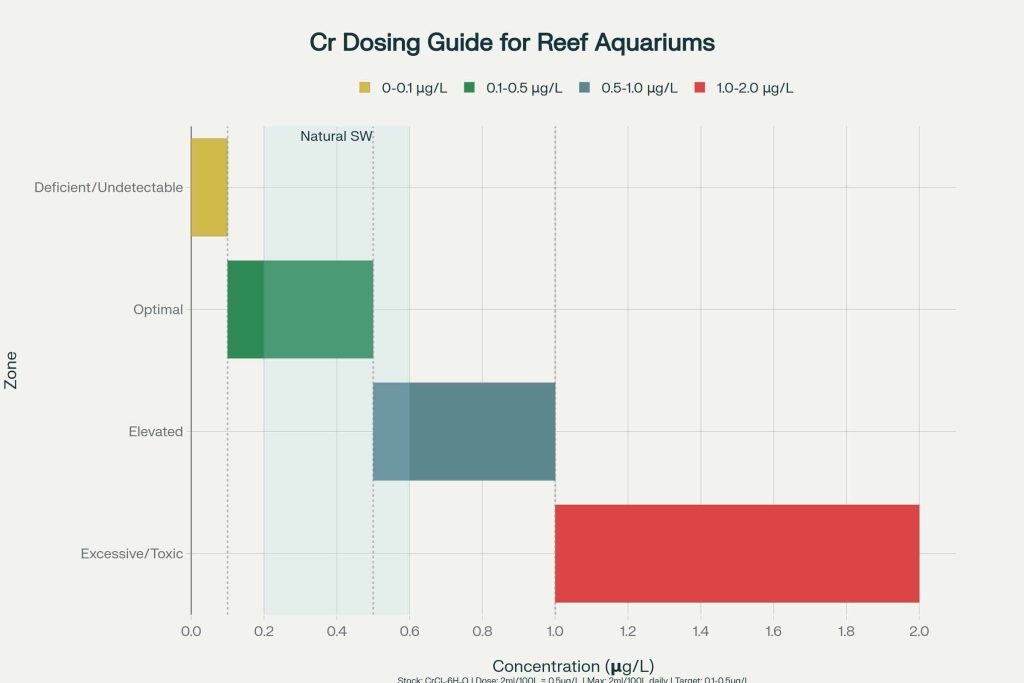
Chromium occurs naturally in seawater at extremely low concentrations ranging from 0.2-0.6 μg/L (0.0002-0.0006 mg/L), making it one of the least abundant yet essential trace elements in marine systems. This concentration range presents significant analytical challenges, as many ICP-OES instruments have detection limits of 0.39-1.3 μg/L, often exceeding natural seawater levels. Even sophisticated ICP-MS systems struggle with reliable quantification below 0.05 μg/L, explaining why aquarium chromium tests frequently return “zero” results despite active supplementation.
Research demonstrates that chromium concentrations in natural reef environments typically vary between 0.04-0.7 μg/L, with significant geographic and temporal variation. The North Sea shows concentrations of 0.7 μg/L, while open ocean measurements often fall in the 0.04-0.5 μg/L range. This natural variability, combined with analytical limitations, makes chromium one of the most difficult trace elements to monitor accurately in reef aquarium systems.
Chemical Forms and Bioavailability
Chromium exists in two primary oxidation states in marine environments: trivalent chromium (Cr³⁺) and hexavalent chromium (Cr⁶⁺). In natural seawater, chromium occurs predominantly as trivalent compounds, including Cr(OH)₃ complexes and various organic chelates. The hexavalent form, while more toxic, is less stable in seawater and typically represents a minor fraction of total chromium.
For reef aquarium supplementation, chromium(III) chloride hexahydrate (CrCl₃·6H₂O) provides the preferred form, as it closely matches the trivalent state found naturally and offers excellent stability in seawater conditions. This compound readily dissolves and forms stable complexes with carbonate and organic ligands, making it bioavailable to coral tissues while minimizing toxicity risks.
Biological Functions in Coral Physiology
Fat Metabolism and Enzyme Formation
Chromium serves essential functions in coral cellular metabolism, particularly in fat metabolism and enzyme synthesis within coral tissues. Research indicates that chromium acts as a cofactor in various enzymatic processes involved in lipid metabolism, enabling corals to efficiently process and utilize fatty acids from both dietary sources and zooxanthellae production. This metabolic function becomes particularly critical in high-energy environments where corals require efficient lipid processing for growth and calcification.
The element’s role in enzyme formation extends beyond simple cofactor activity to include structural functions in metalloenzymes essential for cellular respiration and energy production. Studies suggest that chromium deficiency can lead to compromised fat metabolism, resulting in reduced coral growth rates and diminished response to feeding. This metabolic impairment may manifest as poor polyp extension, reduced calcification rates, and increased susceptibility to environmental stressors.
Calcification Support and Skeletal Development
While not directly involved in calcium carbonate precipitation, chromium contributes to coral calcification through its support of metabolic processes that provide energy for skeleton formation. The element’s role in fat metabolism becomes particularly important for calcification, as lipid-derived energy supports the active transport processes required for calcium and carbonate concentration at calcification sites.
Research on coral calcification indicates that chromium availability may influence the efficiency of energy-dependent calcification processes, with deficient corals showing reduced calcification rates despite adequate calcium and alkalinity levels. This indirect but significant role explains why chromium supplementation often produces improvements in coral growth and skeletal development within weeks of initiation.
Aquarium Applications and Management Protocols
Target Concentrations and Detection Reality
Reef aquarium chromium levels should be maintained within the 0.1-0.5 μg/L range to mirror natural seawater concentrations and support optimal coral physiology. However, the practical reality of chromium management differs significantly from other trace elements due to detection limitations and rapid consumption rates. Even with daily supplementation, ICP tests frequently return “zero” or “below detection limit” results, creating confusion for aquarists who expect measurable responses to dosing.
The disconnect between dosing and detection occurs because chromium consumption by coral tissues often exceeds supplementation rates, particularly in heavily stocked systems with active SPS coral populations. Additionally, chromium’s tendency to form complexes with organic compounds and particles can remove it from the dissolved fraction measured by ICP analysis. This phenomenon necessitates a different approach to chromium management, relying on biological indicators rather than analytical measurements.
Dosing Protocols and Administration
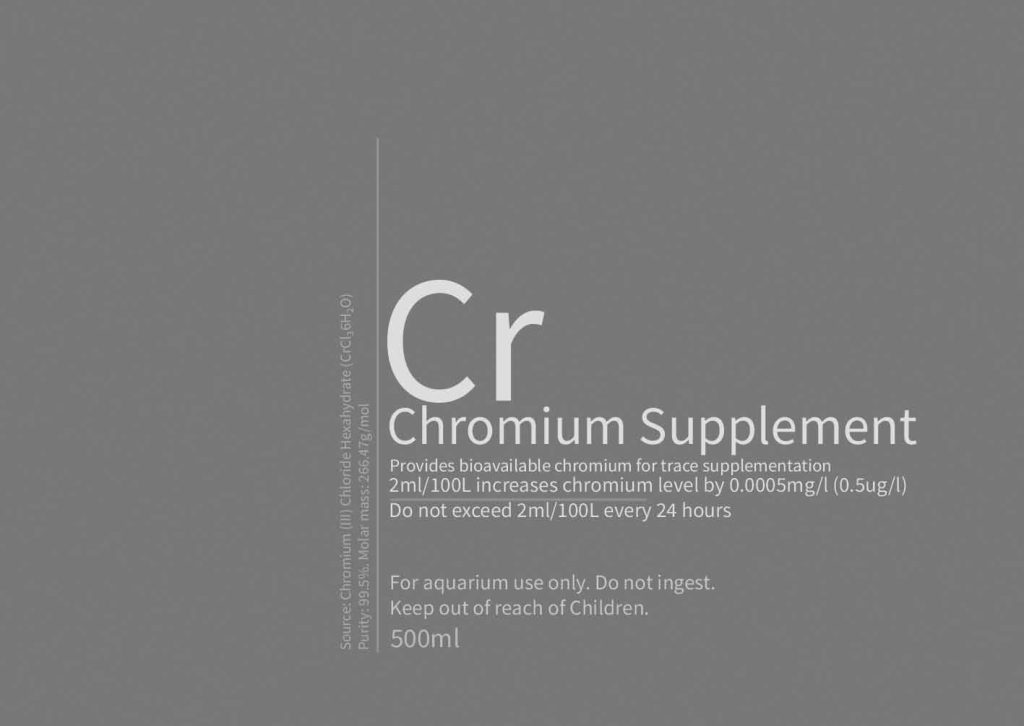
Based on the provided chromium(III) chloride hexahydrate formulation with molecular weight 266.47 g/mol, the dosing protocol follows these parameters:
- Stock Solution: CrCl₃·6H₂O (CAS 10060-12-5)
- Dosing Rate: 2 mL per 100L increases chromium by 0.0005 mg/L (0.5 μg/L)
- Maximum Safe Daily Dose: 2 mL per 100L
- Recommended Range: 0.1-0.5 μg/L
- Dosing Frequency: Daily administration required due to rapid depletion
The daily dosing requirement distinguishes chromium from most other trace elements, reflecting its rapid consumption by coral metabolism and potential loss through various removal pathways. A typical 400L reef system requires 8 mL of stock solution daily to maintain adequate chromium availability, even though ICP tests may continue to show undetectable levels.
This consistent dosing approach ensures continuous availability despite analytical limitations.
Practical Implementation and Biological Monitoring
Chromium supplementation should be administered during periods of peak coral activity, typically during evening hours when feeding responses are most active. The supplement can be dosed directly into high-flow areas to ensure rapid distribution, though the small volumes involved make precise dosing challenging. Many aquarists find success using automatic dosing systems set to deliver small, frequent doses throughout the day rather than single large doses.
Biological monitoring becomes essential for chromium management due to analytical limitations. Improved feeding responses, enhanced polyp extension, and increased coral growth rates serve as primary indicators of adequate chromium availability. Conversely, poor feeding responses and sluggish growth despite optimal major element parameters may indicate chromium deficiency.
Safety Considerations and Toxicity Management
Toxicity Thresholds and Species Sensitivity
Chromium toxicity represents a significant concern at concentrations exceeding natural seawater levels, with marine organisms showing varying sensitivity to chromium exposure. Research indicates that marine fish begin to show stress responses at chromium concentrations above 1.0 μg/L, with acute toxicity effects manifesting at levels exceeding 5-10 μg/L. These toxicity thresholds lie relatively close to therapeutic concentrations, requiring careful dosing protocols and regular monitoring.
Studies on marine fish chromium toxicity reveal that both trivalent and hexavalent forms can cause adverse effects, though hexavalent chromium demonstrates significantly higher toxicity. Symptoms of chromium toxicity in fish include behavioral changes, reduced feeding, mucus secretion, and in severe cases, tissue necrosis and mortality. The narrow margin between beneficial and toxic concentrations emphasizes the importance of conservative dosing approaches.
Bioaccumulation and Organ-Specific Effects
Chromium exhibits significant bioaccumulation potential in marine organisms, with gill tissues typically showing the highest concentrations followed by liver and kidney tissues. In reef aquariums, this bioaccumulation pattern means that chronic exposure to elevated chromium levels can result in organ damage even when acute toxicity symptoms are absent. The accumulation occurs primarily in gill tissues due to direct water contact and active transport processes.
Research on chromium bioaccumulation reveals that accumulated chromium can interfere with osmoregulation and respiratory function in fish, leading to reduced oxygen uptake and altered ion balance. These physiological disruptions can compromise fish immune function and increase susceptibility to disease, making chromium toxicity a serious concern in closed aquarium systems.
Chemical Interactions and Environmental Factors
Chromium toxicity is significantly influenced by water chemistry parameters, particularly pH, alkalinity, and the presence of organic compounds. Higher pH and alkalinity levels tend to reduce chromium toxicity by promoting the formation of less toxic hydroxide complexes. This relationship suggests that well-buffered reef aquarium systems may provide some protection against chromium toxicity.
The presence of organic compounds, including those from coral mucus and bacterial biofilms, can both increase and decrease chromium toxicity depending on the specific compounds involved. Some organic ligands form stable complexes that reduce chromium bioavailability, while others may enhance uptake and toxicity. This complex chemistry underscores the importance of maintaining stable water quality parameters during chromium supplementation.
Integration with Comprehensive Reef Management
Relationship to Other Trace Elements
Chromium’s effectiveness in reef systems depends partly on the availability of complementary trace elements, particularly those involved in enzymatic processes and cellular metabolism. The element’s interactions with iron, manganese, and zinc require careful consideration, as these elements can compete for uptake pathways and influence chromium’s bioavailability. Research suggests that maintaining balanced trace element profiles enhances chromium’s beneficial effects while reducing the risk of antagonistic interactions.
The relationship between chromium and organic compounds extends to amino acid and vitamin supplementation, with some studies indicating that organic chelates may improve chromium uptake and utilization by coral tissues. This interaction suggests potential synergies between chromium dosing and comprehensive nutritional supplementation programs.
Water Change Protocols and Source Considerations
Regular water changes using high-quality salt mixes provide minimal chromium replenishment due to the element’s extremely low concentrations and potential analytical limitations in salt mix quality control. Most commercial salt mixes contain chromium at or near natural seawater levels, but the small quantities involved make significant contributions unlikely through water changes alone. This reality makes targeted chromium supplementation essential for maintaining adequate levels in reef systems.
The choice of salt mix can influence baseline chromium availability, though the differences are typically too small to detect analytically. Some premium salt mixes specifically formulated for SPS coral systems may contain enhanced trace element profiles, potentially including chromium, though manufacturers rarely provide specific chromium content information.
Advanced Applications and Specialized Protocols
Targeted Metabolic Enhancement Programs
Advanced reef aquarists often employ chromium supplementation as part of comprehensive metabolic enhancement protocols designed to optimize coral feeding responses and growth rates. These programs typically combine chromium dosing with amino acid supplementation, controlled feeding regimens, and optimized lighting to maximize coral energy production and utilization.
Research on coral nutrition indicates that chromium supplementation works synergistically with fatty acid-rich foods, particularly those containing marine lipids such as copepods and enriched artemia. This synergy explains why chromium effects are often most pronounced in systems with active feeding programs and diverse dietary inputs.
System-Specific Considerations
Different reef aquarium configurations may require varying approaches to chromium supplementation. Systems dominated by SPS corals typically exhibit higher chromium consumption rates due to active metabolism and rapid growth, potentially necessitating increased dosing frequencies or concentrations. The high surface area to volume ratio of branching corals may contribute to enhanced chromium uptake and utilization.
Soft coral systems may require less intensive chromium supplementation but still benefit from daily dosing, particularly for species with active feeding behaviors. Large polyp stony (LPS) corals, with their substantial tissue mass and active feeding responses, often show dramatic improvements in polyp extension and feeding behavior following chromium supplementation.
Monitoring and Troubleshooting
Alternative Assessment Methods
Given the limitations of chemical analysis for chromium monitoring, reef aquarists must rely on biological indicators and systematic observation to assess supplementation effectiveness. Improved feeding responses typically manifest within 1-2 weeks of initiating chromium dosing, with corals showing enhanced polyp extension and more aggressive capture of food particles.
Growth rate monitoring provides another valuable assessment tool, with chromium-sufficient corals typically showing improved linear extension and tissue expansion. Photography and measurement protocols can help document these improvements over time, providing objective evidence of supplementation effectiveness despite analytical limitations.
Troubleshooting Deficiency and Excess
Chromium deficiency symptoms in reef aquariums include poor feeding responses, sluggish growth rates, and reduced coral coloration despite optimal major element parameters. These symptoms often develop gradually and may be attributed to other factors, making chromium deficiency difficult to diagnose without systematic supplementation trials.
Suspected chromium excess requires immediate attention, as toxicity can develop rapidly once threshold concentrations are exceeded. Signs of chromium toxicity include fish behavioral changes, reduced appetite, and increased mucus production. Coral symptoms may include tissue recession, polyp retraction, and reduced feeding responses. Correction typically requires immediate cessation of dosing combined with enhanced water changes and activated carbon filtration.
Conclusion and Best Practices
Chromium supplementation in reef aquariums requires a unique approach that acknowledges both the element’s essential role in coral metabolism and the practical challenges of monitoring ultra-trace concentrations. The combination of rapid biological consumption, analytical limitations, and narrow safety margins makes chromium one of the most technically demanding trace elements to manage effectively.
Success with chromium supplementation depends on understanding its critical role in coral fat metabolism while accepting the limitations of chemical monitoring. Daily dosing protocols, biological assessment methods, and conservative safety margins provide the foundation for safe and effective chromium management. The element’s ability to enhance feeding responses and support coral growth makes it a valuable component of advanced reef management programs when properly implemented.
The growing understanding of chromium’s metabolic functions in coral tissues continues to refine supplementation protocols and assessment methods. As analytical techniques improve and detection limits decrease, future chromium management may benefit from enhanced monitoring capabilities. However, the fundamental principles of daily dosing, biological assessment, and safety-conscious protocols will remain central to successful chromium supplementation in reef aquariums.