Despite decades of advancement in reef keeping practices, algae problems remain one of the most persistent and challenging issues hobbyists face. Particularly troublesome are Bryopsis and Green Hair Algae (GHA), two invasive algae species that can quickly transform a thriving reef ecosystem into a struggling one. These algae not only impact the health and appearance of aquariums but also significantly affect the economic, psychological, and practical aspects of the reef keeping hobby. Understanding these organisms, their effects on tank ecosystems, and management strategies is crucial for any serious reef enthusiast looking to maintain a balanced and healthy marine display.
Understanding the Invaders: Identifying Bryopsis and Green Hair Algae
Distinguishing between different algae species is the first step toward effective management and control. Bryopsis and Green Hair Algae may appear similar at first glance, but they possess distinct characteristics that differentiate them from each other and determine how they should be addressed in the reef aquarium.
Bryopsis: The Feathery Invader
Bryopsis is a genus of marine green algae in the family Bryopsidaceae, comprising approximately 60 species with a distinctive feathery appearance. At first glance, Bryopsis looks like small patches of underwater grass in reef tanks, starting as very small, thin hair-like strands attached to live rocks or coral that eventually multiply into thick patches. This algae forms dense tufts that can reach up to 40 cm, with each cell made up of an erect thallus that is often branched into pinnules, creating a fern-like structure. The ecological success of Bryopsis has been attributed to its associations with endophytic bacteria that reside in the cytoplasm of their cells, providing benefits such as nitrogen fixation.
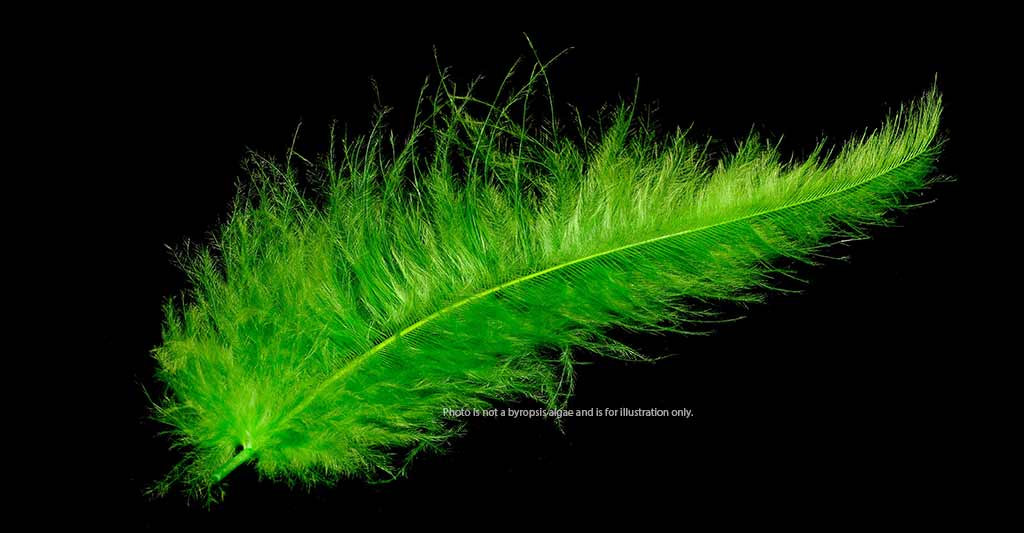
What makes Bryopsis particularly challenging to manage is its unique reproductive mechanism. As an asexual macroalgae, Bryopsis accelerates reproduction through fragmentation, meaning the entire colony self-replicates by releasing cells out into the water column. The life cycle of Bryopsis alternates between an erect macroscopic stage (macrothalli, which are haploid) and a small branched phase (microthalli, which are diploid), with various mechanisms for reproduction that contribute to its resilience in aquarium environments.
Bryopsis begins its “stealthy attack” well before visible signs appear, during which elevated nitrates and phosphate levels might not be detected with standard tests. This algae attempts to hide while its population slowly expands, consuming nutrients and giving the illusion that tank water parameters are correct until it becomes established enough to be challenging to remove as they are adaptive to varying light conditions by developing different types of filaments on its surface and in its lower layers.
Green Hair Algae: The Ubiquitous Nuisance
Green Hair Algae (GHA) is a term that encompasses hundreds of species of green simple filamentous algae that are fine in texture and have few distinguishable features. Unlike Bryopsis, GHA is characterized by its appearance rather than its taxonomy, making species-level identification difficult without a microscope. It gets its name from its distinct appearance, with long, fine, hair-like filaments that can grow rapidly under high nutrient and strong lighting conditions.
In contrast to Bryopsis, GHA breaks apart easily when pulled and loses form quickly when removed from water. Its growth pattern is typically rapid, with the ability to form thick mats within days under the right conditions. GHA attaches to surfaces like rocks, substrates, and corals, which makes manual removal challenging but still more manageable than Bryopsis. Its coloration ranges from bright green in newer growth to darker green or brown as it matures, providing visual cues about its growth stage.

The reproduction mechanism of GHA primarily involves fragmentation (when filaments break off and anchor onto other surfaces) and spore release (which can hitchhike on live rock, plants, or equipment). Under ideal conditions, green hair algae can double its biomass within about a week, rapidly colonizing available surfaces and becoming problematic for reef keepers. The ubiquitous nature of GHA spores and fragments makes keeping it out of tanks via quarantine unlikely to be successful, meaning management approaches should likely be focusing on controlling conditions that limit its growth rather than preventing introduction.
Distinguishing Between Bryopsis and GHA
Correctly identifying which type of algae is present in a reef tank is crucial for applying the appropriate treatment strategy. The most noticeable difference between Bryopsis and GHA is size. Bryopsis algae tend to be larger, both horizontally and vertically compared to GHA, which often features shorter reach. Additionally, Bryopsis algae roots itself deep into the surface of rocks or coral and forms a complex covering that looks like a dense mat, providing it with a sturdy grip to whatever surface it attaches to. In contrast, GHA generally does not have an easily identified root structure, is easily moved off rocks, and can also grow in aquarium substrates.
The branches of Bryopsis are distinct compared to any green hair algae species, with the tiny hair-like strands resembling common variety ferns and featuring dense trunks, while GHA strands are smoother and have less-distinct physical characteristics. Bryopsis has a more structured, feathery, fern-like appearance that differentiates it from GHA, often growing in bushier formations and being coarser and potentially more invasive. If you can make out a root structure or a stiff branching structure, it is probably not GHA but could be Bryopsis or another algae species like Cladophora.
These distinguishing features are important not just for identification but because they influence how each algae type responds to different treatment methods, with Bryopsis typically being more resistant to standard algae control measures compared to most varieties of GHA. Understanding these differences allows reef keepers to tailor their management approach appropriately and avoid wasting time on ineffective treatments that might escalate the problem.
Root Causes: What Drives Algae Proliferation
Understanding the factors that contribute to algae outbreaks is essential for both prevention and effective management. Both Bryopsis and Green Hair Algae thrive under specific conditions that, when addressed, can help limit their growth and spread in reef aquariums.
Nutrient Imbalances
Excess nutrients, particularly nitrates and phosphates, are primary contributors to the growth of both Bryopsis and Green Hair Algae in reef tanks. These nutrients serve as food sources, allowing them to multiply rapidly when present in abundance. Phosphates can enter aquariums through multiple sources, with fish food being a significant contributor, alongside tap water (when not using RO/DI filtration), certain additives, and even through salt mixes. Nitrates can accumulate primarily from fish waste, uneaten food, and the breakdown of organic matter in the aquarium, creating an environment where algae can thrive.
What makes nutrient management particularly challenging with Bryopsis is its ability to mask water quality issues by consuming these nutrients. As Bryopsis populations expand, their consumption of nitrates and phosphates can give the illusion that tank water parameters are pristine, allowing the algae to establish itself before the hobbyist realizes that there is a problem. This was illustrated in one case where after Bryopsis was eradicated with Fluconazole, the tank experienced an unusually high phosphate level of 1.4ppm, revealing how much the algae had been consuming. The sudden removal created a cascade of problems, including coral growth issues and disease outbreaks, demonstrating how deeply algae can influence tank nutrient dynamics.
Poor tank maintenance practices often contribute to nutrient accumulation, as infrequent water changes or inadequate filtration allow waste products to build up. Overstocking fish in the aquarium increases waste production, further elevating nutrient levels and creating conditions for algae growth. Even seemingly unrelated factors like increases in pH can contribute to algae proliferation by affecting nutrient availability and changing how algae can access and utilize these resources. Understanding these nutrient dynamics is crucial for maintaining balance in reef tanks and preventing conditions that favor algae growth over coral health.
Lighting Factors
Artificial lighting plays a crucial role in controlling algae growth in reef aquariums, with excessive light duration and intensity being major contributors to the growth of both Bryopsis and Green Hair Algae. Many aquarium enthusiasts often overlook the impact of lighting on algae growth, focusing instead on providing optimal conditions for corals while inadvertently creating an environment where algae can thrive. Both types of algae are photosynthetic organisms that utilize light energy for growth, meaning that tanks with powerful lighting systems designed for demanding coral species may also unintentionally provide conditions for algae growth.
Light quality, duration, and intensity all influence algae growth patterns, with both direct sunlight exposure and artificial lighting contributing to the problem. Excessive light can stimulate the growth of green hair algae and other algae species, potentially overshadowing the health of beneficial aquarium organisms. Experts recommend a lighting duration of 8 to 10 hours per day to support photosynthesis in healthy corals and plants without providing excessive energy for algae growth, with consistent lighting schedules minimizing stress on tank inhabitants.
For tanks experiencing persistent algae issues, reducing light intensity rather than maximum PAR output can help manage the problem. Additionally, sudden changes in lighting patterns or introducing new, more powerful lighting systems without appropriate acclimation periods can trigger algae blooms. Understanding the relationship between lighting and algae growth allows reef keepers to make informed decisions about their lighting systems, balancing the needs of corals with the goal of minimizing conditions that favor problematic algae.
Introduction Vectors
Understanding how Bryopsis and Green Hair Algae enter reef tanks is essential for prevention strategies, though complete prevention is challenging due to the microscopic nature of algae spores and fragments. These nuisance algae can hitchhike into aquariums through various vectors, including live rock, new coral frags, equipment shared between tanks, and even through fishes. One reef keeper described a situation where helping a friend by temporarily housing a Yellow Tang that had been feasting on algae inadvertently introduced Bryopsis to their previously clean tank, as the algae was present in the fish’s digestive system.
Bryopsis reproduces through microscopic propagules like gametes, spores, and zygotes, which can attach to mature algae or surfaces, leading to new growth and potentially larger infestations. The resilience of these propagules allows them to survive adverse conditions and establish themselves when conditions become favorable, making complete exclusion nearly impossible in open systems. Even in tanks started with completely “dead” dry live rock, different strains of algae can eventually appear without an obvious introduction source, possibly from algae spores carried through the air from other tanks nearby.
Due to the ubiquitous nature of algae spores and fragments, keeping them out of tanks via quarantine procedures alone is unlikely to be successful. This reality has led many experienced reef keepers to focus more on maintaining conditions that limit algae growth rather than attempting to prevent introduction entirely, recognizing that some level of algae is natural and even beneficial in small quantities. Implementing careful quarantine procedures for new additions, thoroughly cleaning equipment between uses in different tanks, and treating new live rock or coral can help reduce the risk of introducing problematic algae, but maintaining proper water parameters and biological balance remains the primary defense against outbreaks.
Ecological Impact: How Algae Affect the Reef Tank Ecosystem
The presence of Bryopsis and Green Hair Algae does not just affect the visual appeal of a reef tank but fundamentally alter the ecological balance and health of the entire system. Their impacts range from direct competition with corals to more subtle effects on water chemistry and nutrient cycling.
Effects on Corals and Other Inhabitants
Both Bryopsis and Green Hair Algae can have severe negative effects on coral health through multiple mechanisms. Bryopsis secretes allelopathic toxins that can slow or halt coral growth and reduce growth, directly inhibiting the development and reproduction of essential reef-building organisms. Physically, these algae can smother corals by growing over them, leading to tissue loss and potentially death as they occupy the corals’ living space and block access to light and nutrients. This is particularly problematic with fast-growing algae like Bryopsis, which can rapidly overgrow sessile organisms that cannot move away from the threat.
The relationship between algae outbreaks and coral health was dramatically illustrated in a case where the eradication of Bryopsis triggered a chain reaction of events that ultimately led to coral deaths. After the Bryopsis was eliminated using Fluconazole, phosphate levels spiked dramatically as there was no longer anything consuming them. When measures were taken to rapidly reduce these elevated phosphate levels, corals that had grown accustomed to higher phosphate availability could not adjust to the sudden change, resulting in growth stoppage. This stress ultimately led to an outbreak of Slow Tissue Necrosis (STN) that killed one-third of the large coral colonies in the tank, demonstrating how algae can become integral to a tank’s nutrient dynamics and how their removal requires careful management of the resulting changes.
Beyond corals, algae outbreaks can affect other tank inhabitants through various mechanisms. In cases of extensive growth, both Bryopsis and GHA can alter habitat structure, potentially affecting the behavior and well-being of fish and invertebrates that may become stressed by changes to their environment. Additionally, decomposing algae can cause oxygen shortages and create hypoxic or anoxic conditions that are lethal to sensitive organisms, particularly in areas of poor water circulation. Green Hair Algae specifically impacts oxygen dynamics by producing oxygen during daytime photosynthesis but consuming it at night, potentially causing oxygen depletion that can stress or even asphyxiate fish in severe cases, especially in smaller tanks or areas with limited water movement.
Water Quality Implications
The presence of significant amounts of Bryopsis or Green Hair Algae can substantially impact water quality parameters in reef tanks if left untreated. They can cause pH fluctuations through photosynthetic activities, which removing carbon dioxide during the day (raising pH) and releases it at night through respiration (lowering pH). These daily swings can stress sensitive reef organisms adapted to the relatively stable pH of natural reef environments, potentially contributing to health issues and reduced growth in corals and other invertebrates that are heavily dependent on stable water chemistry.
Nutrient dynamics are particularly affected by algae growth, as both Bryopsis and GHA efficiently assimilate nitrates and phosphates from the water column. While this may temporarily appear beneficial by reducing measurable nutrient levels, it creates a dangerous illusion of good water quality while masking underlying issues. The tank’s biological filtration and nutrient export systems may not be adequately sized or maintained if the algae has been serving as an unintentional nutrient sink, leading to further problems when the algae is removed.
Decomposing algae breaks down and produces ammonia, which then converts to nitrite and eventually nitrate through the nitrogen cycle. This process increases the overall bioload on the tank’s filtration system and can potentially lead to dangerous ammonia or nitrite spikes if large amounts of algae die off simultaneously, such as after chemical treatments. Additionally, areas of dense algae growth often experience reduced water flow, creating dead zones where detritus accumulates, further compromising water quality. These complex effects on water chemistry highlight why algae management is not simply an aesthetic concern but a fundamental aspect of maintaining a healthy reef ecosystem.
Nutrient Cycling Disruption
The influence of Bryopsis and Green Hair Algae in reef tanks is complex and often underappreciated by hobbyists. These algae are efficient at sequestering nutrients, particularly nitrates and phosphates, which can disrupt the natural balance of the ecosystem and mask underlying problems with tank husbandry. As algae populations expand, their consumption of these nutrients can create the illusion of proper water parameters, allowing issues to go unaddressed until algae growth becomes overwhelming. This nutrient sequestration effectively places the algae in direct competition with beneficial organisms that also require these resources, potentially leading to decline in desired tank inhabitants while the problematic algae thrives.
The case descibed previously where Bryopsis eradication led to a series of catastrophic events perfectly illustrates how deeply algae can integrate into a tank’s nutrient cycles. Once the Bryopsis was eliminated using Fluconazole, there was nothing left to consume the phosphate that had been present in the system, causing levels to spike. When measures were taken to rapidly reduce these phosphate levels, the corals—which had adapted to the higher phosphate environment.
These nutrient cycling disruptions highlight why gradual approaches to algae management are generally recommended over aggressive treatments. The sudden removal of a major nutrient sink can cause more harm than the algae itself if other aspects of tank management aren’t adjusted to compensate for the change. Additionally, the decomposition of algae following treatment can release stored nutrients back into the water column, potentially fueling new algae blooms of different species if not properly managed through proper nutrient control methods. Understanding these complex interactions is essential for successful long-term management of reef tanks affected by problematic algae.
The Hobbyist’s Burden: Economic and Personal Impacts
Beyond their ecological effects, Bryopsis and Green Hair Algae create significant challenges for reef keepers in terms of financial costs, time investments, and emotional impacts. These burdens can influence how hobbyists engage with and experience reef keeping. Specific treatments for algae, such as Fluconazole, can add to the financial burden of reef keeping. However, for hobbyists struggling with persistent Bryopsis outbreaks, Fluconazole may serve as an effective last-resort solution when other methods fail. While Fluconazole is generally reef-safe and effective against Bryopsis, it does not address the underlying conditions that allowed the algae to thrive. Therefore, it should be used alongside efforts to stabilize water parameters and prevent future outbreaks.
Time Investment and Frustration
The psychological burden of this time investment is compounded by the frustration of seeing limited results despite dedicated effort, creating a source of stress that can diminish enjoyment of the hobby. Many hobbyists describe the emotional roller coaster of thinking they have finally gained control over an algae problem, only to see it return or worsen after a period of apparent improvement. This frustration is particularly acute when algae threatens prized coral collections that may represent years of care, adding emotional stakes to the already demanding work of algae management. The time and emotional investments required are significant enough to drive enthusiasts to consider abandoning the hobby entirely.
Winning Strategies: Approaches to Management and Prevention
Despite the challenges posed by Bryopsis and Green Hair Algae, effective management approaches have emerged from years of collective hobbyist experience and research. Successful strategies typically involve multiple complementary techniques rather than relying on a single approach.
Physical Control Methods
Manual removal remains one of the most direct and immediately ways to address visible algae growth, though its success varies between Green Hair Algae and the more persistent Bryopsis. For GHA, manual removal is relatively straightforward: using a toothbrush or a small brush to twirl the strands before pulling them out of the tank. The soft texture of GHA makes it easier to remove than Bryopsis, though care must be taken to prevent fragments from spreading and establishing elsewhere in the tank. For more accessible objects covered in algae, removing them from the tank for cleaning in a separate container prevents released fragments from finding new places to attach to.
Bryopsis presents a greater challenge for manual removal due to its deeper root structure, allowing it to spread rapidly when disturbed. Hobbyists attempting to manually remove Bryopsis are often advised to combine this approach with water changes immediately afterward to remove floating fragments, as well as to employ targeted spot treatments on the affected areas. Some reef keepers report success with removing rocks or hardscape elements completely from the tank for more aggressive cleaning, though this approach risks disrupting beneficial bacteria colonies and disturbing tank inhabitants. The limited effectiveness of manual removal alone for Bryopsis explains why many hobbyists eventually turn to chemical treatments or biological controls after becoming frustrated with persistence of this algae despite regular manual removal efforts.
Beyond manual removal, physical control methods also include techniques to improve water circulation and reduce areas of low flow where algae can establish more easily. Positioning powerheads to eliminate dead spots, cleaning pump intakes regularly to ensure optimal flow, and periodically rearranging rockwork to prevent detritus accumulation can all contribute to an environment less favorable for algae growth. While physical control methods rarely resolve severe algae problems completely, they remain an important component of comprehensive management strategies and are often the first line of defense against algae growth
Biological Control Approaches
Harnessing natural predation and competition represents one of the most sustainable and effective long-term strategies for managing both Bryopsis and Green Hair Algae. Cleanup crews consisting of algae-consuming invertebrates can significantly reduce algae populations while contributing to overall ecosystem function in the reef tank. For Green Hair Algae, various snail species including Mexican Turbos, Astrea, and ceriths can effectively graze on the algae and keep it in check when stocked at appropriate densities. Urchins, particularly Tripneustes gratilla, are effective at keeping turf and close-cropped hair algae under control, though their potential to disturb tank décor means they must be selected carefully based on tank setup.

Bryopsis presents a greater challenge for biological control due to its tough structure and potential chemical defenses, but some specialized herbivores have shown effectiveness against it. Lettuce nudibranchs (Elysia crispata) specifically target Bryopsis and can be particularly valuable for controlling this algae on corals that other grazers cannot safely access. Some reef keepers report success with sea hares, which can voraciously consume various algae types including Bryopsis, though their survival in captivity can be challenging and their waste production must be considered when adding them to established systems. Crustaceans like emerald crabs and Sally Lightfoot crabs can supplement the cleanup crew by picking at algae and consuming detritus that might otherwise feed algae growth.
Beyond direct consumption, another biological approach involves introducing competing organisms that outcompete problematic algae for resources. Live macroalgae compete directly with nuisance algae for essential nutrients like nitrogen and phosphorus, effectively limiting the resources available for Bryopsis or GHA to thrive. These biological control methods not only help manage algae but also contribute to a more natural, balanced ecosystem.
Chemical Treatments and Water Parameters
When biological and physical control methods fails, chemical approaches and water parameter adjustments offer additional tools for managing persistent algae problems. The antifungal medication Fluconazole has emerged as a surprisingly effective treatment specifically for Bryopsis, with reports of complete eradication within just three days of treatment. Fluconazole disrupt cellular processes specific to Bryopsis while generally having minimal impact on other tank inhabitants when used as directed. However, as demonstrated by the case where Bryopsis eradication led to phosphate spikes and coral health issues, chemical treatments must be followed by careful monitoring and management of the resulting changes in tank chemistry.
Beyond Fluconazole, adjusting key water parameters can create conditions less favorable for algae growth. Maintaining proper magnesium levels (above 1400 ppm) has been identified as a potentially limiting factor for some types of algae, including slime algae varieties. While the mechanism is not fully understood, many experienced reef keepers have observed correlations between low magnesium levels and problematic algae growth, suggesting that testing and maintaining appropriate magnesium concentration may be part of comprehensive algae management strategies. Similarly, maintaining stable alkalinity levels appropriate for the specific corals being kept can help prevent conditions that favor algae strive.
Nutrient control through chemical filtration media represents another important approach, with phosphate-removing media being particularly valuable for creating conditions less favorable to algae. Products containing ferric oxide (GFO) or aluminum oxide are commonly used in reactors or filter bags to bind phosphates and remove them from the water column. While effective when properly employed, these media must be replaced regularly as they become saturated, and their use must be balanced with the needs of corals and other photosynthetic organisms that require some level of nutrients to thrive. Carbon dosing methods, which involve adding simple carbon sources that fuel beneficial bacteria capable of consuming dissolved organic compounds and nutrients, represent another chemical approach to reducing nutrients available to algae. These various chemical and parameter-based approaches highlight the multifaceted nature of effective algae management, which typically requires addressing both the symptoms and underlying causes of problematic growth.
The Evolving Reef Hobby: Innovations and Sustainable Approaches
The challenges posed by Bryopsis and Green Hair Algae have pushed the reef keeping hobby to evolve, with innovations in technology, management practices, and community knowledge sharing that benefit not just algae control but overall reef keeping success and sustainability.
Technological Advancements
The reef keeping hobby is experiencing a technological revolution that promises to transform how hobbyists prevent and manage algae problems with tools that can analyze water parameters, temperature, and nutrient levels in real-time, sending alerts when adjustments are needed before conditions become favorable for algae growth. These systems can track trends in tank conditions and predict potential issues, enabling preemptive action before algae gains a foothold. Automated dosing and feeding systems calculate exact amounts of supplements and food needed, reducing the risk of overfeeding or inconsistent nutrient levels that often contribute to algae problems.
Lighting technology has also seen remarkable advancements, with hybrid and full-spectrum lighting systems that more effectively mimic natural sunlight while providing options for customization that can help limit algae growth. These systems include precise UV spectrum adjustments to enhance coral coloration and growth while allowing hobbyists to reduce light intensity in ways that disadvantage algae without compromising coral health. App-controlled customization enables fine-tuning of lighting schedules and intensity, providing dynamic lighting effects that simulate natural conditions while making it easier to implement the reduction in photoperiod often recommended for algae management. These smart lighting systems represent a significant improvement that offered limited control options, making it easier to adjust lighting in response to early signs of algae issues.
Water testing and monitoring technologies have similarly advanced, with continuous monitoring systems replacing occasional manual testing and providing much more consistent and reliable data. These systems can detect changes in water chemistry that might indicate conditions becoming favorable for algae growth before visible problems arise. When combined with automated water change systems and programmable equipment controllers, these technologies create comprehensive management systems that maintain more stable conditions, the key to preventing most algae problems before they begin. While these technological solutions represent additional investment, many hobbyists find they ultimately save money by preventing costly problems and reducing the time commitment required for successful reef keeping.
Community Knowledge and Sustainable Practices
The reef keeping community has evolved significantly in its approach to algae management, moving away from the early days’ simple advice of “lower your nutrient levels to as close to zero as possible” toward more ecosystem-based approaches. Today, many successful reef keepers maintain nutrient levels at higher values than previously recommended, having discovered that near-zero nutrient systems often struggle with coral health and coloration issues. This evolution in thinking represents a more sophisticated understanding of reef ecosystems as complex, interconnected systems rather than isolated parameters to be controlled individually. Community forums, social media groups, and dedicated websites have facilitated rapid knowledge sharing about effective algae management approaches, accelerating the learning curve for new hobbyists while helping experienced reef keepers refine their techniques.
Conclusion: The Ongoing Battle and Future Prospects
The challenges posed by Bryopsis and Green Hair Algae remain significant for reef hobbyists, but our understanding of these organisms and approaches to management have evolved considerably. Rather than viewing algae control as a binary success-or-failure proposition, many experienced reef keepers now approach it as an ongoing management process that requires attention to multiple facets of tank husbandry. This shift in perspective acknowledges that some level of algae is natural and even beneficial in appropriate quantities, while focusing efforts on preventing problematic overgrowth.
The development of more efficient technologies, more targeted treatment approaches, and better preventive strategies offers the reef keeping community more refine methods for algae control through collective experience sharing, experimenting and documentation, creating an evolving knowledge base that helps newcomers avoid the most challenging pitfalls.
Looking toward the future, the integration of artificial intelligence in monitoring systems, advances in automated equipment, and the continued development of biological control methods promise to make reef keeping more accessible despite the persistent challenge of algae management. At the same time, the hobby’s increasing focus on sustainability and ecosystem-based approaches aligns reef keeping more closely with conservation efforts, potentially transforming what was once seen primarily as a collection hobby into a community that actively contributes to marine conservation. While Bryopsis and Green Hair Algae will likely remain persistent challenges, the reef keeping hobby’s response to these challenges demonstrates impressive resilience and innovation that will continue to shape its evolution in the years ahead.